

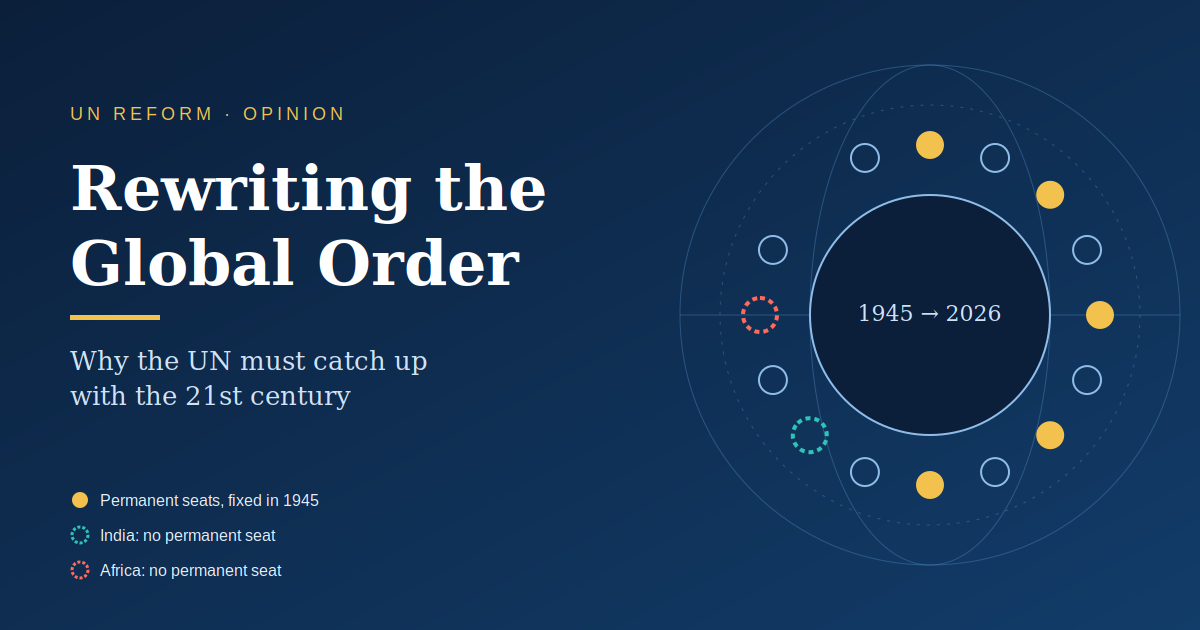
The United Nations was designed for a world that has largely vanished. When its founders drew up the Security Council in 1945, Europe lay in ruins, most of Africa and Asia lived under colonial rule, and a handful of victorious powers believed they could keep the peace by holding the veto. Eight decades later, dozens of nations have gained independence, economies have risen and fallen, and the centre of gravity of global affairs has shifted. Yet the structure at the top of the UN has barely moved.
An institution that claims to speak for humanity cannot afford to reflect only the balance of power of one historical moment. Its legitimacy depends on whether the world sees itself in it. Today, a growing part of the world does not.
The Representation Gap
The clearest symptom is the composition of the Security Council. Its five permanent members were fixed at the end of the Second World War, and the arrangement has never been meaningfully revised. Two regions bear the cost most visibly.
India is the world's most populous country and one of its largest economies, a major contributor to UN peacekeeping, and a nuclear-armed democracy with growing influence across the Global South. A body that makes decisions on global security without India as a permanent voice is missing a fifth of humanity from the table.
Africa is even more striking. The continent has 54 countries and well over a billion people, and much of the Security Council's agenda, from peacekeeping missions to sanctions to conflict mediation, concerns African states. Yet Africa has no permanent seat and no veto. Decisions about the continent are often made without it holding equal weight in the room.
This is not a question of prestige. It is a question of whether the people most affected by decisions have a real say in making them.
Four Reforms for a Realistic World Order
1. Bring India into permanent decision-making.
Including India would acknowledge demographic, economic and strategic reality. It would also strengthen the Council, since a body that reflects the world's actual power distribution enforces its decisions with more authority.
2. Give Africa meaningful representation.
Africa's exclusion from permanent membership is a historical anomaly, not a principled position. Reform should give the continent a permanent voice, so that its priorities are shaped by Africans and not only discussed on their behalf.
3. Adopt the Equal Earth map.
This may sound symbolic, but symbols shape perception. The widely used Mercator projection inflates the size of regions far from the equator and shrinks Africa and other tropical regions, distorting how we picture the world. The Equal Earth projection preserves the true relative size of landmasses. If the UN, which shapes how the world understands itself, adopted a map that shows continents in fair proportion, it would send a small but powerful signal about equality.
4. Place global chokepoints under multilateral governance.
A large share of world trade and energy flows through a few narrow passages, such as straits and canals. When a few nations control or dominate them, the whole world's economy is exposed to their politics. Placing these routes under a UN-based framework, with clear rules of neutral and open passage, would reduce the risk that vital arteries of global commerce are used as instruments of pressure.
Why the Obstacles Are Real, and Why They Shouldn't Win
Reform is difficult. Changing the Charter requires the consent of the very powers who benefit from the current arrangement, and disagreement over which countries should join has stalled progress for decades. Chokepoint governance would meet sovereignty concerns from the states that border these routes.
But difficulty is not an argument against change. It is an argument for starting earlier, building coalitions across regions, and being honest that an unreformed UN risks irrelevance. When countries lose faith in an institution, they build alternatives, and a fragmented world with rival bodies is more dangerous than an imperfect but inclusive one.
The United Nations was a remarkable achievement for its time. But institutions survive by adapting, not by preserving the past. A UN that includes India, gives Africa its rightful voice, represents the world honestly on the map, and protects the global commons from unilateral control would be stronger, more legitimate and more effective. The world has changed. It is time for the UN to change with it.
No comments yet.