

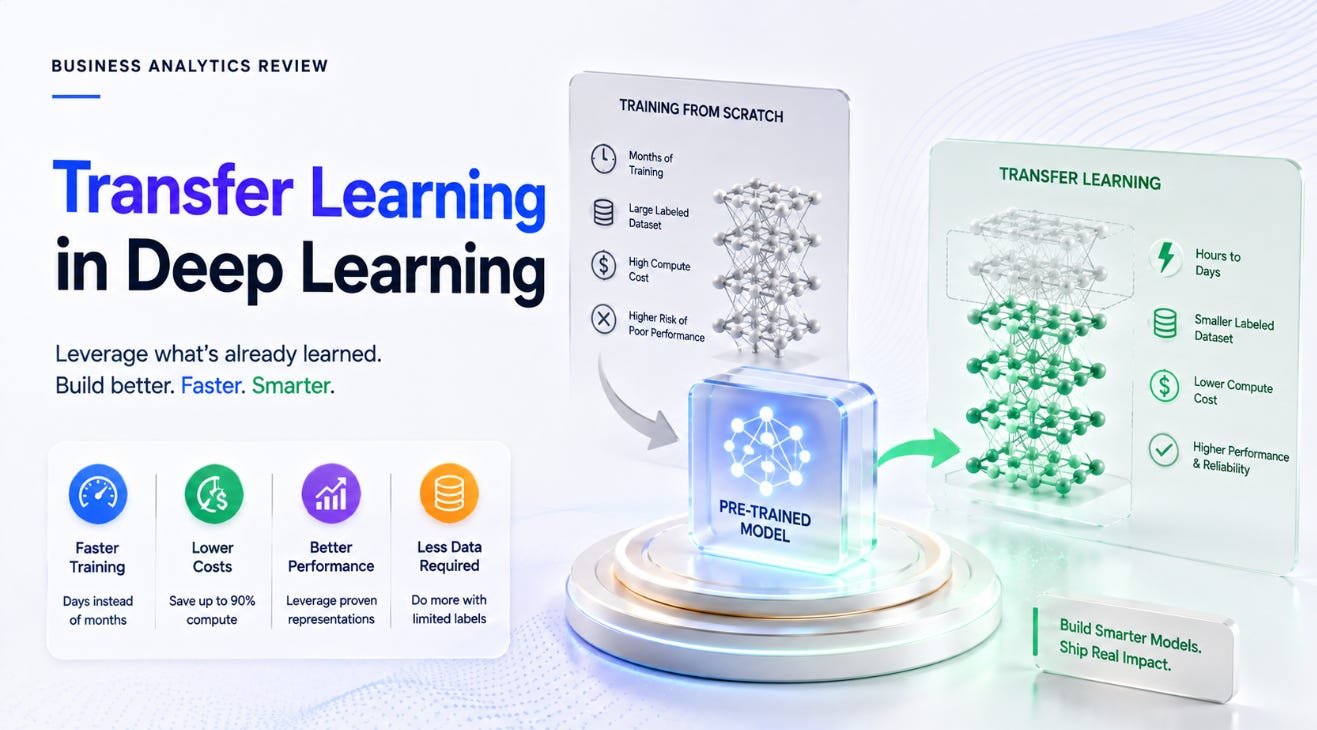
Training deep neural networks from clean initialization states is quickly becoming one of the most expensive anti-patterns in modern enterprise machine learning. Engineering teams routinely spend six-figure cloud compute budgets and months of trial-and-error gathering labeled datasets, only to discover their custom architecture performs worse than a standard baseline. The underlying paradox is stark: while data volume grows exponentially, high-quality, task-specific labeled data remains brutally scarce and expensive to acquire.
When teams build vision or language models from scratch, they force their neural networks to relearn fundamental representations of the world on every single run. A computer vision system must spend thousands of GPU hours discovering basic low-level concepts like edges, textures, and geometric contours before it can ever learn to distinguish a surgical tool from a manufacturing defect. This structural inefficiency not only inflates infrastructure bills, but also slows down organizational deployment velocity to a crawl.
Transfer learning completely overturns this paradigm by treating feature representation as a reusable software dependency rather than an ad-hoc output. By transferring weight matrices from massive models pre-trained on broad datasets like ImageNet or broad language corpora, engineering organizations can bootstrap new domain applications using a tiny fraction of the data and compute previously required.
The Core Problem: Why Status-Quo Approaches Fail
The traditional pipeline of training deep neural networks from random weight initializations breaks down across three distinct operational vectors: statistical inefficiency, extreme computational cost, and brittle convergence. When a network starts with randomized parameters, every layer must learn both feature extraction and task classification simultaneously. Without tens of millions of labeled samples, high-capacity models quickly memorize noise in small datasets, resulting in severe overfitting and poor out-of-domain generalization.
From an infrastructure perspective, training state-of-the-art architectures from scratch requires massive compute clusters running continuous parallelized optimization loops for weeks. Small data science teams simply cannot compete with the hardware footprint needed to optimize hundreds of millions of parameters from zero. This creates a high capital barrier to entry, effectively locking mid-sized enterprises out of building custom deep learning capabilities unless they leverage pre-computed representations.
Finally, training deep architectures from zero is notoriously unstable. Optimization algorithms often get trapped in suboptimal local minima or suffer from vanishing and exploding gradients, requiring laborious hyperparameter tuning across learning rates, weight decay, and layer normalization schedules. Starting from an uninitialized state means spending valuable engineering sprint cycles fighting numerical instability rather than refining domain-specific business logic.
Key Takeaway: Training from scratch forces models to repeatedly learn foundational patterns; transfer learning converts pre-computed visual and textual representations into instant operational leverage.
The Paradigm Shift: What You Need to Know
To systematically deploy transfer learning, engineering leaders must structure their model pipeline around three fundamental operational pillars:
- Feature Extraction vs. Fine-Tuning: In feature extraction, the pre-trained model layers remain completely frozen, acting as a fixed numerical encoder while only a lightweight classifier head is trained on new data. Fine-Tuning goes a step further by unfreezing select deep layers or the entire network, adjusting pre-trained weights with a small learning rate to adapt internal feature maps directly to domain subtleties.
- Domain Alignment and Shift: Transfer learning success relies heavily on the distance between the source domain and the target domain. While visual models trained on natural images adapt quickly to consumer goods, medical imaging or specialized satellite imagery often requires target-specific layer adaptation or intermediate self-supervised pre-training to resolve domain distribution shifts.
- Parameter-Efficient Adaptation (PEFT): Modern transfer learning, particularly in large language models like BERT or transformer variants, leverages techniques like Low-Rank Adaptation (LoRA) and prefix tuning. Instead of modifying billions of base parameters, teams freeze the primary weights and inject tiny trainable rank-decomposition matrices, slashing memory overhead by up to 90 percent during fine-tuning.
A Quick Story From the Field
A mid-sized logistics firm recently attempted to build an automated visual inspection pipeline to scan shipping containers for structural damage at regional depots. Their initial engineering approach involved training a custom Convolutional Neural Network (CNN) from scratch using a internal dataset of 12,000 manually tagged images. After three weeks of cluster training and aggressive hyperparameter tuning, the custom model capped out at an unsatisfactory 71 percent validation accuracy, frequently missing critical stress fractures due to dataset size limitations.
Recognizing the architectural bottleneck, the team pivoted to a transfer learning approach using a pre-trained ResNet backbone initially optimized on ImageNet. They froze the early convolutional layers to retain general visual features like edges and structural boundaries, replaced the top dense classification layer, and fine-tuned the final residual block using a low learning rate.
The entire re-architecture required less than four hours of GPU training time on a single instance. The fine-tuned model achieved 94.5 percent validation accuracy on the exact same 12,000-image dataset, while cutting inference deployment latency by half through optimized layer quantization. By leveraging pre-computed feature detectors, the team delivered a production-ready asset two months ahead of schedule while reducing total cloud compute expenditure for the project by 82 percent.
What This Means for You
Strategic implementation of transfer learning requires a clear roadmap for balancing model accuracy against compute budgets and technical debt. Organizations should evaluate off-the-shelf pre-trained backbones as the default baseline before allocating engineering hours to custom model design. Evaluating source domain alignment early allows teams to choose between lightweight feature extraction for fast prototyping and deep fine-tuning for mission-critical precision.
On an operational level, teams must standardize their testing, versioning, and fine-tuning procedures to maintain model reliability over time. Establishing strict validation benchmarks against domain drift, using parameter-efficient fine-tuning frameworks, and maintaining clean data pipelines ensures that engineers can rapidly adapt pre-trained assets to new business tasks without risking catastrophic forgetting or unmanageable infrastructure bloat.
AI & LLM Hacks: Practical Workflows for Transfer Learning in Deep Learning
- Automated Backbone Selector: Prompt your LLM to act as a machine learning architect by describing your target domain dataset size, hardware constraints, and latency targets. Request a ranked list of recommended pre-trained model backbones (e.g., EfficientNet, ResNet, BERT, RoBERTa) along with precise layer freezing strategies tailored to your specific sample count.
- Layer Unfreezing Strategy Generator: Pass your current PyTorch or TensorFlow model training loop into the model and request an automated learning rate scheduler script. The prompt should generate code that implements discriminative fine-tuning, applying smaller learning rates to earlier pre-trained layers and larger learning rates to top classification heads.
- Catastrophic Forgetting Diagnostic: Use an LLM to evaluate your fine-tuning configuration by providing your loss function, batch size, and learning rate parameters. Ask the model to audit the setup for risks of catastrophic forgetting, returning specific parameter adjustments like elastic weight consolidation or gradient clipping thresholds.
No comments yet.